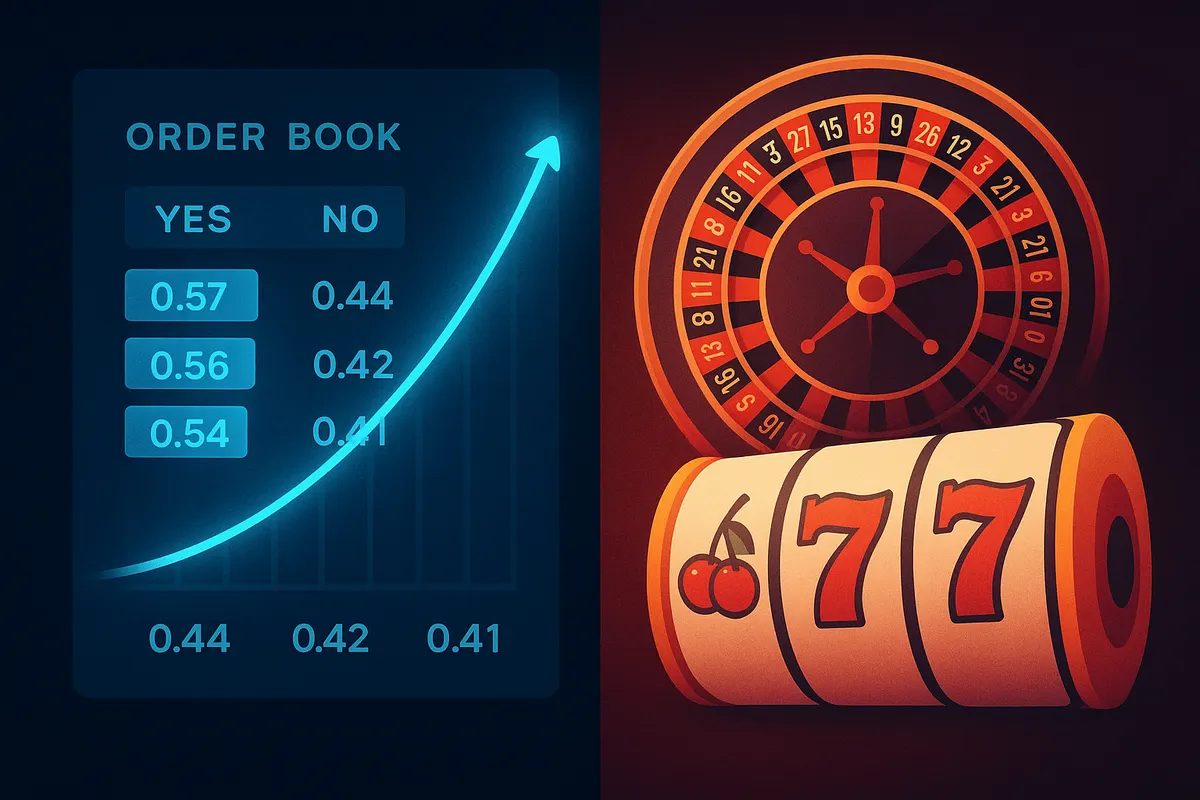
Ever seen a market quoting “Will this happen?” at 68 cents and wondered whether you’re looking at a bet, a trade, or something dressed up as both? That question sits at the centre of a fast-growing corner of online wagering, and it got a fresh burst of attention when Coinbase Ventures and CMCC Global backed Raven, a liquidity provider for prediction markets, in a round that valued the firm at $90 million.
Here are prediction markets explained without the hype, structured around the misconceptions I hear most often. Some of them are half right, which is exactly what makes them stubborn.
Prediction markets explained: what you actually buy
A prediction market is a platform where people trade contracts tied to the outcome of a real-world event: an election result, a central bank decision, a sports fixture, whether a company ships a product by a certain date. Most contracts are binary. One side (“Yes”) pays a fixed amount if the event happens, the other side (“No”) pays if it doesn’t, and the two together are worth exactly one unit at settlement.
Because of that, the price is the probability. If Yes trades at 0.68, the market is collectively saying roughly 68%. Buy a Yes share at 0.68 and you risk 0.68 to win 1.00, which is the same shape as decimal odds of about 1.47 (1 ÷ 0.68). Sell it, or buy No at 0.32, and you’re taking the other side of the same estimate.
Two things follow from that structure. First, you’re trading against other participants, not against a fixed paytable. Second, you usually don’t have to wait for settlement: if the price moves to 0.80, you can sell and bank the difference, or cut at 0.50 and take a smaller loss. That optionality is the single biggest mechanical break from a casino round, which resolves the instant the reels stop.
Myth 1: “It’s just a sportsbook with a different interface”
Superficially similar, structurally different. A bookmaker sets a price, takes your stake, and carries the risk itself. Its prices are built with a margin baked in, the overround, so the implied probabilities across a market add up to more than 100%. Your counterparty is the house, and the house is not neutral about the result.
On a prediction market, the venue is closer to an exchange. It matches your order against somebody else’s and earns from fees or spreads rather than from your loss. Yes and No prices tend to sit near 1.00 combined, with the gap between the best bid and best offer as the visible cost of crossing the spread. That’s why the pricing on a liquid event contract often tracks consensus probability more tightly than a bookmaker’s posted odds.
Where the myth has teeth: the emotional experience is nearly identical. You stake money on an uncertain outcome, you can lose all of it, and the same chase-your-losses reflexes apply. Calling it “trading” doesn’t change what your bank statement sees.
Myth 2: “No house edge means the odds are in my favour”
This one costs people real money. No structural house edge is not the same as no cost and definitely not the same as positive expected value.
Before settlement, a prediction market is close to zero sum: winners are paid out of losers’ stakes. Then the frictions come off the top. Bid-ask spreads on thin markets. Trading fees. Deposit, withdrawal or on-chain network fees on crypto platforms. Settlement rules that resolve in a way you didn’t expect because you skimmed the contract wording. After those, the average participant is below break even, and the counterparty who just filled your order may well be a professional firm with better models than yours.
Compare the honest arithmetic. A slot at 96% RTP carries a 4% house edge over the long run. European roulette sits at 2.7%. A prediction market doesn’t publish a number like that, so the cost is easier to underestimate rather than genuinely absent. If you want the full picture of how built-in margins work across formats, our guide to reading betting odds and implied probability covers the maths in more detail.
Myth 3: “Someone behind the curtain is setting the odds”
Nobody hands down the price. It emerges from an order book, the live list of buy and sell offers at each price level. When a big buyer lifts every Yes offer up to 0.74, the market’s stated probability moves to 74%. Sentiment, news and money flow do the work that an odds compiler does at a sportsbook.
What a market maker like Raven actually does
An order book only works if there’s something in it. That’s the job of liquidity providers, also called market makers: firms that post both a bid and an offer on the same contract so you can trade immediately instead of waiting for a matching counterparty to wander in. They aim to earn the spread across huge numbers of trades while managing the inventory risk they take on.
Raven is one of these firms. Founded in 2023, it moved into prediction markets in the second quarter of 2025 and has since made markets in thousands of event contracts, alongside market making in traditional financial assets and liquidity provision for digital asset and token projects. Its recent financing round, led by Coinbase Ventures and CMCC Global, put a $90 million pre-money valuation on the business, with CMCC co-founder Charlie Morris joining the board. The individual cheque sizes weren’t disclosed. For context, that valuation is more than triple the $25 million the company carried after a $2.7 million seed round in 2024 led by Hack VC, with Wintermute Ventures among the participants.
Worth being precise here: Raven isn’t a place you go to place a trade. It’s plumbing. Retail users interact with the platforms; firms like Raven make those platforms tradeable.
Why liquidity decides whether the price means anything
In a thin market, a single modest order can drag a contract from 0.55 to 0.70, and the quoted “probability” is then mostly noise. Wide spreads also mean you pay to get in and pay again to get out. As Gemini’s research on market makers puts it, without them prediction markets would be illiquid, slow and inaccurate; competition between makers is what tightens spreads and keeps a Yes price honestly reflecting collective estimates.
Practical takeaway for anyone browsing: check the order book depth before the headline percentage. A 62% quote on a market with a few hundred dollars of resting orders tells you far less than a 62% quote on a market with real two-way volume.
Side by side: the differences that matter
| Feature | Prediction market | Sportsbook | Casino game (slots, roulette) |
|---|---|---|---|
| Your counterparty | Other traders, matched peer to peer | The bookmaker | The house |
| How the price is set | Order book supply and demand | Odds compilers plus margin | Fixed paytable and RNG maths |
| Built-in cost | Spread plus trading and transfer fees | Overround inside the odds | House edge (100% − RTP) |
| What decides the result | A real-world event | A real-world event | A random number generator |
| Exit before the result | Usually yes, sell your position | Sometimes, via cash-out at a worse price | No, each round settles immediately |
| Does information help? | Yes, but you compete with pros | Yes, within account limits | No, spins are independent |
| Long-run maths | Near zero sum minus fees | Negative EV from margin | Negative EV, e.g. 2.7% on European roulette |
Myth 4: “Because it’s skill-based, I can’t really lose”
Skill genuinely matters more here than on a slot reel. Research, domain knowledge and discipline about position sizing change your results in a way nothing changes an RNG outcome. But three realities keep that from becoming a money printer.
- Your edge has to beat the spread and fees before it beats anyone’s opinion.
- The obvious edges get arbitraged away quickly, often by algorithmic firms operating at speeds retail can’t match.
- Being right about the world isn’t enough; you also have to be right about the exact contract wording and resolution source.
And a related myth worth puncturing: institutional backing is not a safety rating. Venture investors funding market makers are betting on a business model, not certifying that individual participants will do well.
The crypto prediction platforms people actually use
Polymarket is the name most retail traders recognise, running crypto-settled event contracts across politics, sport, economics and culture. Augur was the early Ethereum-based attempt at a fully decentralised betting market and matters more as a design ancestor than as a busy venue today. Kalshi took the opposite route, operating as a regulated US event contracts exchange. Limitless is among the larger prediction markets operating outside the US, and Coinbase Ventures also holds stakes there, plus in Earlybird, which lets users trade on outcomes tied to privately held companies, and in Billy Bets, an autonomous AI agent that trades sports event contracts on venues like Polymarket.
Availability is the catch. These platforms restrict access by jurisdiction, and the legal position on event contracts and online real-money wagering differs sharply from country to country and, in India, from state to state. If you’re reading from India, treat access, tax treatment of any gains and the underlying legality as things to verify for your own situation rather than assume. The same caution applies to funding an account with crypto, a topic we unpack in our crypto gambling explainer.
Why institutional money keeps arriving
The investment thesis rests less on gambling volume than on information. A liquid prediction market produces a continuously updated, money-backed probability estimate, which is useful to newsrooms, hedge funds, campaign teams and anyone forecasting demand. Investors who believe that data has commercial value want exposure to the infrastructure that produces it.
Market makers are an attractive slice of that stack. They earn from activity rather than from picking outcomes, they scale with volume across many contracts at once, and they’re the reason any of these venues function at all. Add partial regulatory clarity in some jurisdictions, which lets exchanges list contracts under recognised frameworks, and you get the valuation jumps seen at Raven: $25 million in 2024 to $90 million pre-money in the latest round.
None of that says anything about your results. It says professionals expect trading activity to grow.
Before you put money anywhere
Whichever format you prefer, the risk of loss is real and the entertainment framing should stay front of mind. Set a deposit limit you’d be comfortable losing entirely, keep prediction market positions separate from money you need, and use the cool-off, loss-limit and self-exclusion tools any responsible operator provides. Our responsible gambling guide covers those tools in practice. If wagering has stopped feeling like a choice, step away and talk to a support service; nobody should be funding a market position with money earmarked for rent. This content is educational and isn’t financial, legal or tax advice.
Frequently asked questions
How do prediction markets work in simple terms?
You buy shares in an outcome at a price between 0 and 1 that reflects its implied probability. Winning shares settle at 1, losing shares at 0, and you can usually sell your position before settlement at whatever the market is currently paying.
What is market liquidity in prediction markets?
Liquidity is how easily you can trade a contract without moving its price. Market makers such as Raven supply it by quoting both a buy and a sell price continuously, which narrows spreads and keeps quoted probabilities meaningful.
Are prediction markets better odds than a casino?
They avoid a fixed house edge, but they aren’t free. Spreads, platform fees and transfer costs come out of your returns, and you’re trading against informed counterparties. The average participant still loses money over time.
Is a prediction market gambling?
Legally it depends on the jurisdiction and how the contract is structured. Practically, you are risking money on an uncertain outcome, so the same bankroll discipline and responsible gambling habits apply.


Leave a Reply