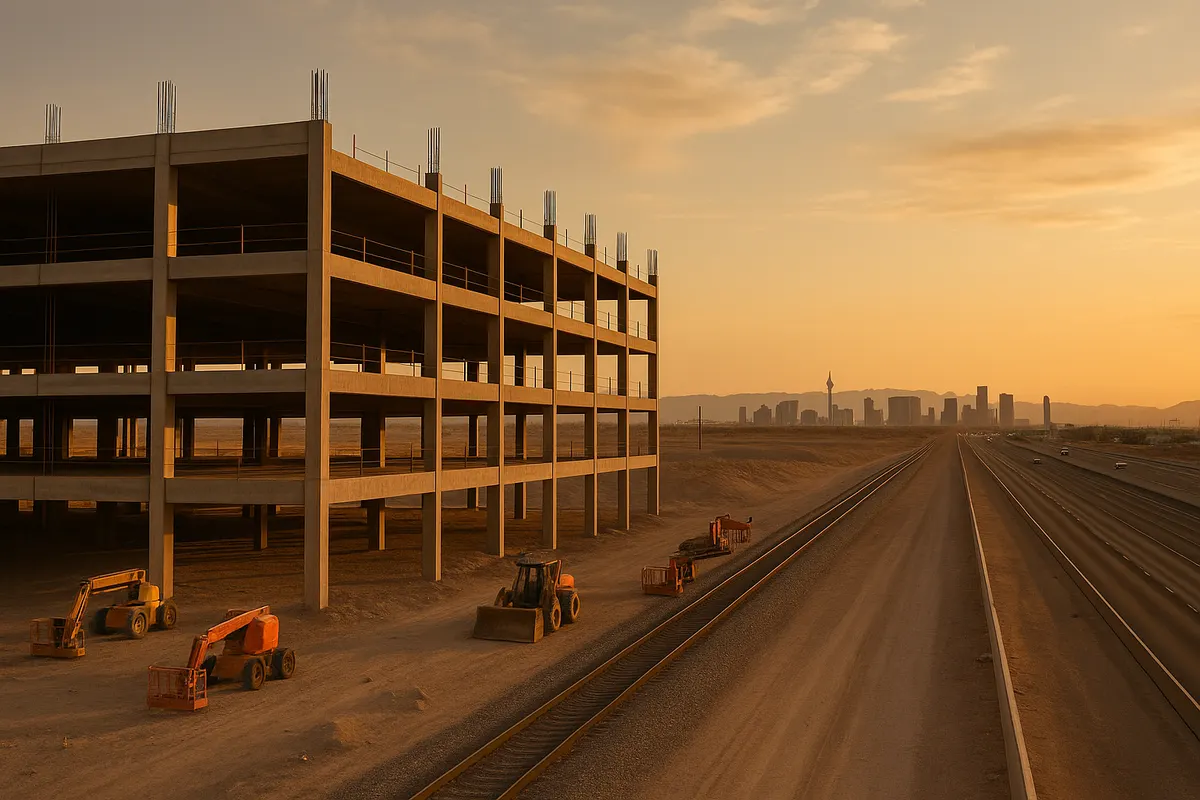
Six months of quiet at a 110-acre lot on Las Vegas Boulevard
The clearest signal about the future of Vegas casino tourism travel right now is not a press release. It is a parking garage on Las Vegas Boulevard, somewhere between Blue Diamond and Warm Springs roads, that nobody has worked on in at least half a year. Grading was done. Sewer and storm drains went in during 2025. The garage got started. Then the crews stopped showing up, and no new construction phase has been announced.
That garage is supposed to serve the Las Vegas terminus of Brightline West, the 218-mile high speed line meant to carry passengers from the south end of the Strip to Rancho Cucamonga in about two hours at speeds up to 200 mph, running down the median of Interstate 15. Track laying across the Mojave, the expensive part, has not begun at all.
The bankruptcy that officially has nothing to do with the Vegas train
Then came the paperwork. Brightline Holdings and roughly 16 affiliated companies filed for Chapter 11 protection in New Jersey, entering a restructuring support agreement with existing investors to put another $490 million into the Miami-to-Orlando railroad. Brightline Trains Florida, the entity that actually runs those trains, did not file, and Florida service continues.
Brightline West is a separate legal entity with overlapping ownership rather than a wholly owned subsidiary of the Florida operation, which is the technically correct and strategically useful distinction the company leaned on. A spokesperson told the Las Vegas Review-Journal that the Florida bankruptcy “has no bearing” on the Vegas project, and that the focus remains on completing the financing and moving the project forward.
Both things can be true. The corporate firewall may well hold, and the Vegas line can still be stuck. Financing is the whole ballgame here, and the family name on the bond documents just went through bankruptcy court. That does not help.
From the 2028 Olympics to “late 2029”
This project has been slipping for years, which matters more than any single filing. Fortress-backed Brightline picked up the older XpressWest plan in 2018 and rebranded it Brightline West in 2020. The original pitch was to have trains running in time for the 2028 Olympic Games in Los Angeles, a date that was already gone before the Chapter 11 filing. The current target is late 2029.
Meanwhile the price went the other direction. After a ceremonial groundbreaking in April 2024, the estimated cost nearly doubled, from about $12.4 billion to $21.05 billion according to federal project documents and later reporting. The project holds $3 billion in federal funding, which sounds enormous until you set it against a $21 billion budget. The remaining gap is the reason the parking garage is sitting there.
| Milestone | Status |
|---|---|
| Brightline takes over XpressWest plan | 2018 (renamed Brightline West in 2020) |
| Ceremonial groundbreaking | April 2024 |
| Cost estimate | Rose from ~$12.4B to $21.05B |
| Las Vegas terminus site work | Began 2025 on ~110 acres; now appears stalled |
| Heavy construction in the I-15 median | Not started |
| Original completion goal | 2028 LA Olympics (missed) |
| Current completion target | Late 2029 |
What high speed rail to Vegas would actually change for casino tourism travel
Take the trip as designed and follow it through. You board near the south end of the Strip, ride roughly two hours to Rancho Cucamonga, and transfer to Metrolink for Los Angeles. Stops are planned in Hesperia and the Victor Valley, with a possible future station at the Southern Nevada Supplemental Airport near Jean, Nevada, which Clark County hopes to open somewhere between 2035 and 2037.
The interesting part for anyone who follows gambling travel is not the speed. It is what the train removes. No parking fee. No four-hour drive that turns into six on a holiday Sunday when the I-15 becomes one long brake light. No designated driver, which quietly changes the economics of a night out for the resorts. Rail shortens the decision window for a Southern California visitor from “do I want to spend a weekend on this” to “do I want to spend a Saturday on this.”
That is the real prize: converting drive-market weekenders into casual day-trippers, and pulling in people who would never voluntarily get on the 15. Southern California has always been the backbone of the Las Vegas drive market, and the entire Brightline West thesis is that a two-hour train ride makes that market bigger and more frequent rather than merely more comfortable.
Casino destination access without the train
Absent the line, nothing collapses. Vegas has been filling hotel rooms off the I-15 and McCarran, now Harry Reid International, for decades. But the status quo has a ceiling, and Las Vegas visitor numbers are sensitive to exactly the frictions a train would have smoothed: fuel prices, airfare, parking charges, resort fees, and how much of a weekend gets eaten by the journey.
There is a broader pattern worth noticing. Casino destination access tends to be decided by infrastructure, not by marketing budgets. Macau’s mass-market boom tracked the arrival of ferry capacity, the Hong Kong-Zhuhai-Macau Bridge and high speed rail into Guangdong. Singapore’s integrated resorts sit on top of one of the best-connected airports in Asia. Regional US casinos have grown for a decade on the simplest advantage there is, which is being 40 minutes from home rather than 400 miles. Where the transport goes, the gambling spend follows, and it is not a coincidence that the Brightline West station plan includes a stop at a future airport.
Why a stalled railroad is an iGaming story
Because gambling tourism trends and online play are two halves of one wallet. Every hour of travel friction between a player and a casino floor tilts the balance toward the version of gambling they can reach from the sofa, whether that is a licensed online casino in a regulated state, a sportsbook app, or a regional property closer to home. Operators know this, which is why the big Strip brands spend so much effort linking digital accounts to land-based loyalty programmes. The train was, in effect, a distribution channel for the physical product.
Three practical implications for readers who follow this ecosystem:
- Trip planning. If you had “take the train to Vegas” penciled in for 2029, treat it as unconfirmed. Heavy construction has not started, and a line of this scale does not get built in the time remaining unless the financing lands soon.
- Reading operator strategy. Watch how Strip operators talk about the drive market and visitation in earnings calls. Softer access assumptions usually mean more promotional spend, more aggressive room offers, and more push into digital channels rather than fewer.
- Judging future projects. Groundbreakings are theatre. Track in the ground, signed financing and an announced construction phase are evidence. Apply the same test to the next casino resort or rail project that gets a rendering and a ribbon.
What would count as real progress
Ignore statements about focus and momentum. Three concrete things would signal the Vegas line is alive: a closed financing package covering the gap between the $3 billion in federal funding and the $21.05 billion estimate, a formal notice-to-proceed for heavy construction in the I-15 median, and crews back at the parking garage on Las Vegas Boulevard. Until at least one of those happens, the safe assumption for Vegas casino tourism travel is the same one that has applied since 2018: you drive, or you fly.
Frequently asked questions
Is the Las Vegas to Los Angeles high speed rail project cancelled?
No. Brightline West says it is still pursuing financing and targets late 2029 for completion. But its Las Vegas terminus site work appears stalled, track laying has not started, and its affiliated Florida parent companies have filed for Chapter 11, which makes the timeline look optimistic.
Did the Brightline bankruptcy include the Vegas project?
Brightline Holdings and around 16 affiliates filed. Brightline Trains Florida, the operator, did not, and Florida service continues. Brightline West is a separate legal entity with overlapping ownership, and the company says the filing “has no bearing” on the Vegas line.
How fast would the train be compared with driving?
The plan calls for up to 200 mph over 218 miles, about a two-hour trip from Las Vegas Boulevard to Rancho Cucamonga, with a Metrolink transfer for Los Angeles. Driving the same corridor typically takes around four hours and considerably longer at peak weekend times.
A note on play: casino games carry a built-in house edge and produce losses over time for players on average, whether you get there by train, car or phone. Set a budget before you travel, use deposit and session limits where they are offered, and treat gambling as entertainment spending rather than income. Support services such as the National Council on Problem Gambling are available if play stops being fun.

Leave a Reply