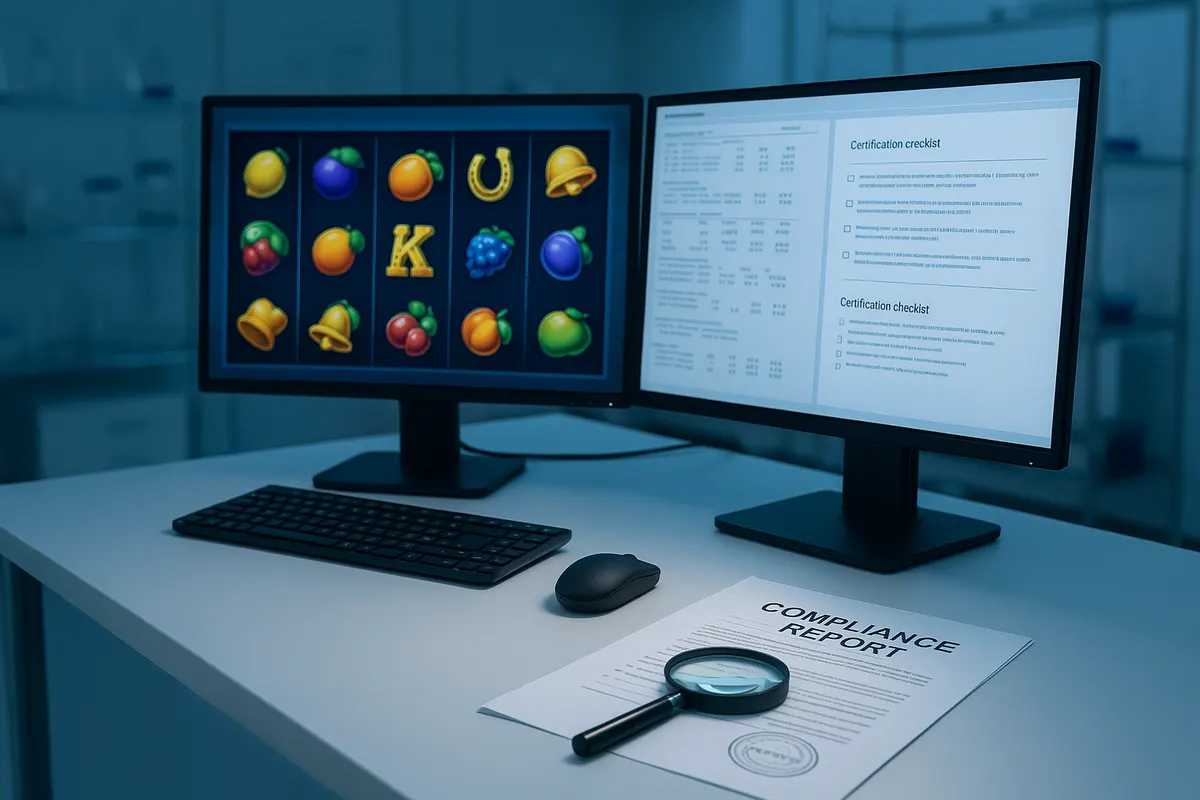
It’s late, you’ve just funded an account, and before you spin you scroll to the very bottom of the site. Somewhere under the payment logos there’s a small grey badge. A lab name. Maybe a certificate number. Most players scroll straight past it. That badge is doing more work for you than the flashy welcome bonus at the top of the page.
That is the honest case for casino testing labs, and it’s worth restating now that two of the better known names in the business sit under one owner. Independent testing doesn’t make a game generous. It makes a game honest. Those are very different promises, and the industry blurs them constantly.
The Visualize Group completes its eCOGRA acquisition and folds it into BMM Testlabs
The Visualize Group, a private investment firm focused on mission-critical businesses, has completed its previously announced acquisition of eCOGRA, the testing, inspection, certification and compliance (TICC) provider formerly owned by Hanover Investors Management LLP. The deal was first announced on 30 June 2026 and closed after customary regulatory approvals and clearances.
With the close, eCOGRA joins BMM Testlabs, which Visualize acquired earlier in 2026, as the firm continues building out a TICC platform for the gambling industry. According to Visualize, the combined business now holds licences or accreditations in more than 800 jurisdictions, covering close to every market in the world with a legal, regulated gambling industry, which lets it support suppliers entering newly regulated markets from day one.
Strip away the corporate language and what’s happened is simple: two independent labs that certified games for operators and regulators are now commercially part of the same group. Whether that’s good news for players depends entirely on what these labs actually do, so let’s start there.
What independent casino testing labs actually do
Independent casino testing labs are technical auditors. They take a game or a gambling platform, examine its code and its mathematics, run it through statistical testing, and certify whether it behaves as advertised and as the local regulator’s technical standards require. They are hired by game studios, operators and regulators, and their certificates are what a licensing body looks at before approving a game for a market.
Three pieces of that work matter most to you as a player.
Game software testing
A lab reviews the game build itself: the paytable, the symbol weightings, the bonus trigger logic, the maths model. Then it simulates the game over an enormous number of rounds to confirm the theoretical return to player (RTP) the studio claims is the RTP the code actually delivers. If a slot is sold as 96.2% RTP, the lab’s job is to prove the software doesn’t quietly pay 92%.
Testing also covers the unglamorous stuff that ruins sessions: does the game recover correctly if your connection drops mid-spin? Does it display the correct balance and bet? Does it show RTP and game rules where the regulator demands it? Live dealer tables get their own treatment, including the card-reading hardware and shuffle procedures.
RNG verification
The random number generator decides every outcome, so it gets the deepest scrutiny. Labs examine the RNG source code and its seeding, then subject its output to batteries of statistical tests looking for uniform distribution, independence between rounds and the absence of predictable patterns or serial correlation. They also check how the RNG’s raw numbers are scaled onto reel positions or card values, because a sound RNG can still be mapped badly.
Payout rate audits
Certification is a snapshot of software. Payout audits are ongoing. A lab collects real wager and win data from a live operator over a period and reports the actual payout percentage by game category. Some operators publish these reviews. They are useful, with one caveat worth internalising: a monthly figure of, say, 95.8% across thousands of players tells you the maths is working as designed. It says nothing about your afternoon.
| What the lab tests | What it examines | What it tells you as a player |
|---|---|---|
| RNG | Source code, seeding, statistical output tests | Outcomes are random and independent; past spins don’t influence the next one |
| Game maths | Paytable, symbol weights, simulated RTP | The advertised RTP matches the code |
| Game behaviour | Error handling, disconnection recovery, rules display | Interrupted rounds resolve correctly |
| Live dealer setup | Card recognition, shuffling, studio procedure | Physical games follow the stated rules |
| Payout reporting | Real wager and win data over a set period | Actual returns line up with theoretical returns across all players |
| Compliance | Local technical standards, responsible gambling tools | Deposit limits, self-exclusion and reality checks work as required |
How eCOGRA certification works
eCOGRA is a UK-based TICC provider founded in 2003, so it has spent more than two decades testing online gambling software and auditing operators. Its work splits roughly into two halves: technical certification of games, RNGs and platforms against the standards of the jurisdictions an operator is licensed in, and operator-level compliance review covering areas such as player fund handling, terms and conditions, and responsible gambling controls.
For players, eCOGRA certification usually shows up as a seal in a casino’s footer. A meaningful seal is clickable and leads to a certificate or report page on eCOGRA’s own site naming the operator and the date of the audit. A flat image that links nowhere is decoration, not evidence.
One thing certification is not: a rating of how good a casino is to play at. It is a statement that specific software and specific processes were examined against a defined standard at a defined time. Read it that way and it becomes genuinely useful.
Where BMM Testlabs fits in game verification
BMM Testlabs comes from the other side of the industry. It is one of the longest established independent gaming test labs, with roots in land-based slot machines and casino systems, and it works extensively with regulators as well as suppliers. Its accreditation footprint is the reason Visualize highlighted that 800-plus jurisdiction number: a supplier that wants to launch in a newly regulated market needs a lab that is already recognised by that market’s regulator.
The two businesses complement each other more than they overlap. BMM’s strength is breadth of regulatory recognition across land-based and online, machines and systems; eCOGRA’s is online-native certification plus operator compliance auditing. Combining them creates a lab group that can follow a game from the studio to the cabinet to a mobile screen in a freshly regulated jurisdiction.
Why RNG audits matter for fair play
An RNG audit is the only reason you can reasonably trust that a slot spin isn’t being nudged. Without one, you are taking a private company’s word that the software it wrote and profits from is fair. That’s not a trust model anyone should accept with their own money.
A proper audit does three things. It confirms the generator produces statistically random, uniformly distributed output. It confirms outcomes are independent, which is the technical basis for the fact that machines are never hot or cold and a long losing run doesn’t make a win “due”. And it confirms nobody, including the operator, can reach in and change the odds on a live game, because the certified build is fingerprinted and any change requires recertification.
Audits need repeating because software changes. New maths models, new jurisdictions, new platform versions. A certificate from years ago on a game that has been updated since is worth less than players assume.
Crash games have pushed this further with provably fair mechanics, where you can verify an individual round yourself using server and client seeds. That is a genuinely stronger guarantee for the rounds it covers, but it verifies randomness, not the house edge baked into the paytable. Both approaches confirm the game is honest. Neither makes it beatable.
What the merger means for players
Short version: nothing changes today, and the practical value of fair play certification is unchanged. Certificates issued by either lab remain valid, the technical standards are set by regulators rather than by labs, and the jurisdictions that accredited these labs continue to supervise them.
The plausible upside is coverage. A single group accredited across more than 800 jurisdictions can certify a game once and take it into many markets faster, which in practice means players in newly regulated markets get access to properly tested games sooner instead of unregulated alternatives.
The fair concern is concentration. Independent testing derives its value from independence and from competition between labs, and every merger in this space leaves fewer separate names bidding for the same work. I don’t think that is a crisis here, mainly because labs answer to regulators who accredit them and can pull that accreditation. But it is worth watching, and it is a reason to value the fact that other independent labs are still operating.
How to check that your casino uses certified games
This matters more for players in India than in most places, because the sites Indian players typically land on are licensed offshore rather than at home. When the regulator is thousands of kilometres away, third-party testing is one of the few verification tools you actually control.
- Scroll to the footer. Look for lab seals and a licence statement naming the regulator and a licence number.
- Click the seal. It should open a certificate or verification page on the lab’s domain, naming this operator. If it’s a dead image, treat it as marketing.
- Check the licence separately. Look up the licence number on the regulator’s own register rather than trusting the badge. Our guide to casino licensing covers how to read one.
- Look at the game providers. Established studios certify their games for the markets they supply. A lobby full of unnamed clones is a warning sign in itself.
- Open the game info screen. A tested game usually states its RTP and full rules in the paytable. Missing or vague RTP disclosure is a red flag.
Other things that should make you close the tab: certification claims with no lab named, seals for labs that don’t exist on the lab’s own client list, audit reports with no dates, and support staff who can’t tell you who tests their games.
FAQ
What do casino testing labs do?
They independently test gambling software and platforms: reviewing RNG code, verifying game maths and advertised RTP, checking error handling and rules display, auditing real payout percentages, and confirming compliance with each jurisdiction’s technical standards before a regulator approves a game.
How does eCOGRA certification work?
eCOGRA tests games, RNGs and platforms against the standards of the operator’s licensing jurisdiction, and audits operator processes such as player funds and responsible gambling tools. Certified operators display a seal that should link to a dated certificate on eCOGRA’s site.
What is BMM Testlabs?
BMM Testlabs is one of the longest established independent gaming test labs, working with regulators and suppliers across land-based and online gambling. It was acquired by The Visualize Group in early 2026 and now includes eCOGRA’s business.
Why are RNG audits important?
They verify that outcomes are random and independent and that nobody can alter the odds of a certified live game. Without an audit, you are trusting the operator’s own word about software it profits from.
One last point, because it’s the one the seals can’t tell you: certification confirms a game pays what it says it pays, and what it says it pays is always less than 100% over the long run. The house edge is the design, not a flaw. Set a deposit limit, treat the spend as entertainment money, and use the self-exclusion and reality check tools that those same audits exist to verify. If gambling stops feeling like a game, take a break and reach out to a support service.


Leave a Reply