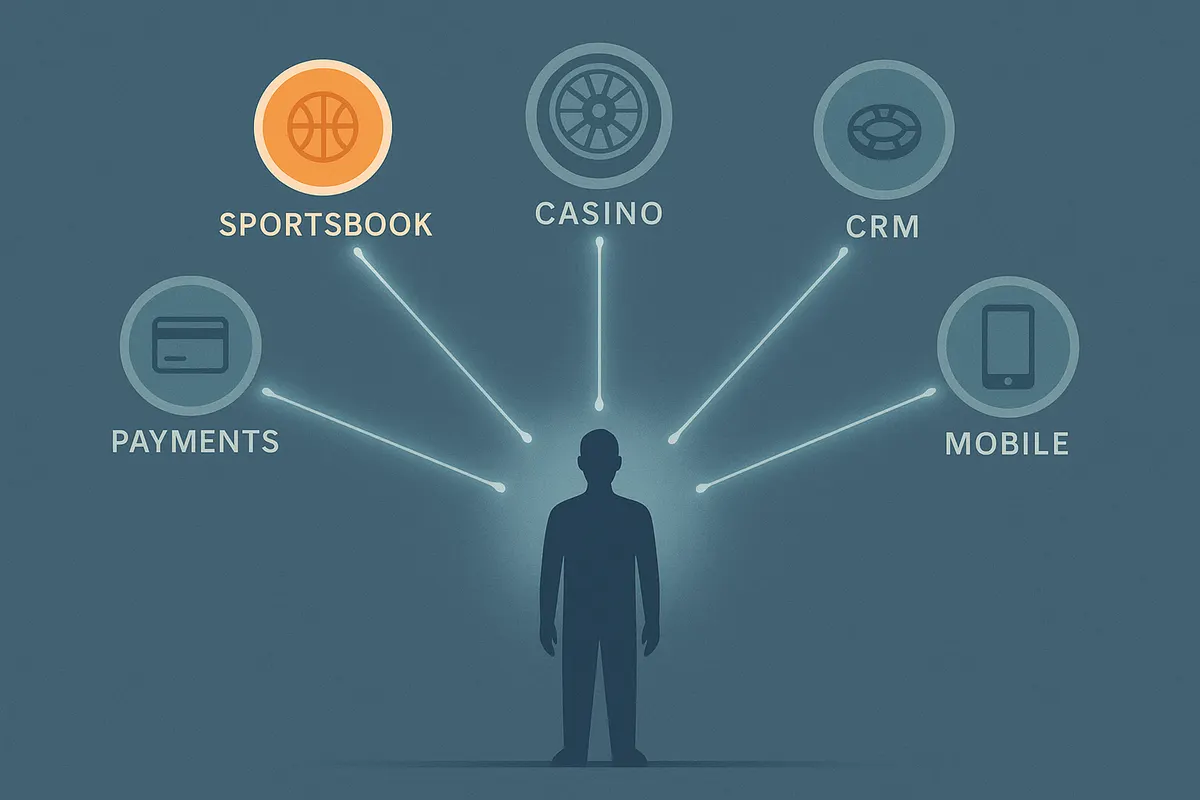
What Digitain’s ‘We Know the Player’ positioning actually means
More than two decades of building betting and casino technology sits behind Digitain’s new positioning concept, and that number is the whole argument. When the Armenia-based supplier launched “We Know the Player” in late September 2026 as a complement to its existing “Built to Lead” brand message, it wasn’t announcing a product. It was staking a claim about accumulated knowledge: how players make decisions, where they hit friction, what makes them stay.
Player-centric iGaming is the design philosophy that treats the platform as one connected player journey rather than a shelf of separate products. Digitain says it applies that player knowledge across its Sportsbook, CRM, Payments, Mobile, Casino and Retail solutions, and explicitly frames the platform as a journey instead of a collection of modules. The positioning statement is marketing language. The underlying shift is real, and it’s worth understanding properly, because most of what gets said about it is half wrong.
So let’s do this the useful way: five things people commonly believe about player-centric platforms, and what’s actually going on.
Myth 1: “Player-centric” is just a nicer interface
Reality: interface polish is the last 10% of it. The substance is architectural.
In a product-centric platform, the sportsbook has its own account logic, the casino has its own bonus engine, payments live in a separate silo, and the CRM sees whatever crumbs those systems bother to pass along. A player who deposits by UPI, plays a live Teen Patti table, then wants a cricket bet on the same balance experiences three different products wearing one skin. Every handoff is a place to lose them.
A player-centric build inverts that. One player profile, one wallet, one event stream, and every product reading from the same record. When Digitain describes integrating player knowledge across sportsbook, CRM, payments, mobile, casino and retail, that’s the claim being made: the journey is the unit of design, not the module. It’s an unglamorous engineering position, which is exactly why it takes twenty years of operating data to argue for it credibly.
Myth 2: Casinos only really track your deposits
Reality: deposits are the least interesting data an operator holds.
Modern platforms capture a continuous behavioural stream, and the aggregate of small signals predicts behaviour far better than transaction totals do. Understanding what’s collected is the honest starting point for any conversation about player data personalisation, and it’s information players are entitled to ask about under data protection rules in most regulated markets.
Where the data comes from
- Registration and KYC data: identity verification, age, jurisdiction, declared details. This sets the legal boundaries for everything that follows, including which bonuses a player may legally be shown.
- Transactional data: deposit and withdrawal methods, amounts, frequency, failed payment attempts. A repeatedly declined card is a churn signal, not just a payments problem.
- Gameplay data: games opened, stake sizes, session length, bet types, time of day, whether a player uses auto-spin or auto cash-out in crash games.
- Navigation and device data: what a player searched for and abandoned, how they arrived, mobile versus desktop, where the app slows down.
- Engagement data: which messages get opened, which bonuses get claimed and which sit untouched until they expire.
Behavioural analytics and player segmentation
Raw events are noise. Analytics turns them into segments, and segments into decisions. The basic mechanic is clustering players by observed behaviour rather than by demographics: a low-stake, high-frequency slots player who plays fifteen minutes on a commute is a different animal from a weekend live-casino player with larger stakes and longer sessions, even if both are 34 and deposit the same amount monthly.
From there, operators build player journey maps and predictive models. Typical outputs include churn probability, likely game affinity, next-best-action for the CRM, and risk flags for potential harm. Older segmentation was static and refreshed weekly; current systems recalculate in or near real time, so a player’s segment can shift during a session.
| Data signal | What it indicates | Typical platform response |
|---|---|---|
| Session length rising sharply week on week | Possible escalation or harm risk | Reality check prompt, limit reminder, human review |
| Bonus claimed but never wagered | Offer mismatch or unclear terms | Different offer type, clearer wagering explanation |
| Repeated failed deposits | Payment friction | Alternative method surfaced at checkout |
| Narrow game repertoire, high hit-frequency preference | Low-volatility affinity | Recommendations weighted to similar volatility |
| Dormant 21+ days after regular activity | Churn risk | Reactivation message, subject to marketing consent |
Myth 3: Personalisation just means more bonus emails
Reality: the email is the crudest expression of it. The interesting work happens inside the product, and it shapes the casino player experience in three distinct places.
Dynamic bonus optimisation
Blanket offers are wasteful in both directions. A 100% match up to a large cap with 40× wagering is irrelevant to a player who stakes ₹20 a spin, and undervalues someone who’d have deposited anyway. Optimisation engines match offer type, size and mechanics to observed behaviour: free spins on a game the player already likes, cashback for a high-volatility player, a low-wagering non-sticky bonus for someone who has abandoned bonuses before.
Worth being blunt here, because personalisation doesn’t change the maths. A bonus is still subject to its wagering requirement, game weighting and max cashout. A ₹1,000 bonus at 30× means ₹30,000 wagered before withdrawal, and every one of those rounds carries the game’s house edge. A well-targeted bonus is a better-fitting offer, not a better deal on the underlying odds.
Personalised game curation
A modern casino lobby can hold several thousand titles, which is unusable without filtering. Recommendation engines rank by behavioural similarity, usually blending collaborative filtering (players like you also played X) with content attributes such as volatility, mechanics, theme and RTP band. Done well, a player who favours low-volatility, high-hit-frequency slots stops being shown swingy Megaways titles they’ll bounce off in four spins.
The quiet benefit is discovery for smaller studios. A relevance-ranked lobby gives a good game with no marketing budget a route to the players who’d actually enjoy it, which a “most popular” carousel never will.
Adaptive responsible gambling tools
This is where player knowledge earns the most and gets discussed the least. The same behavioural models that predict game affinity also detect markers of harm: chasing losses after a downswing, deposit frequency climbing, sessions creeping into the small hours, limits being raised repeatedly, cancelled withdrawals followed by immediate play.
Adaptive tools respond to the individual rather than firing generic pop-ups at everyone. Deposit, loss and session limits stay permanently available, but the platform can surface them at the moment they’re relevant, trigger reality checks on a pattern rather than a fixed timer, and escalate to human contact or a cool-off suggestion when the signals warrant it. In many regulated markets, monitoring for signs of harm and intervening is an obligation, not a nicety, which means the analytics stack and the compliance stack are now the same stack.
If you gamble, set your own limits before you need them, and treat any session as paid entertainment rather than a way to make money. The house edge guarantees the operator profits over time.
Myth 4: This costs operators money and returns goodwill
Reality: the business case is straightforward, and it’s why player knowledge betting strategy has moved from marketing decks into product roadmaps.
Three pressures are doing the pushing. Acquisition costs in competitive markets have risen to the point where retaining an existing player is far cheaper than buying a new one, so anything that reduces friction or improves relevance pays back quickly. Regulation in maturing markets has tightened around advertising, affordability and harm prevention, which penalises operators who market indiscriminately and rewards those who can prove they understand each account. And with much of the industry running similar game catalogues from the same suppliers, content alone no longer differentiates anyone.
That leaves the journey itself as the competitive surface: how fast withdrawals clear, whether the lobby is navigable, whether offers make sense, whether the app works on a mid-range phone. Every one of those depends on knowing who you’re serving.
Myth 5: This is one supplier’s slogan, not an industry shift
Reality: iGaming positioning tends to lag behind what buyers are already asking for, and that’s what makes this announcement a useful signal. Digitain didn’t invent player-centric design; it named a direction the procurement conversation had already taken.
Read the framing carefully and you can see what operators are shopping for: unified data across sportsbook and casino, CRM that acts on behaviour rather than schedules, payments treated as part of the experience instead of a back-office function, and responsible gambling built into the same pipeline as personalisation. Expect more suppliers to position on knowledge and journey design rather than module counts.
For operators evaluating these claims, the questions worth asking are unsentimental. Does one player profile genuinely span every product, or is it three databases with a shared login? Does segmentation update in real time or overnight? Are harm indicators wired into the same model that drives offers, or bolted on to satisfy an auditor? And can a player see, export and delete their data on request? A platform that can answer all four is player-centric. One that can’t has a tagline.
Frequently asked questions
What is player-centric iGaming?
It’s a platform design approach that treats the whole player journey, across casino, sportsbook, payments and support, as a single connected experience built around one player profile, instead of running separate products that happen to share an account.
How do casinos use player data?
Operators combine KYC details, transaction history, gameplay events and navigation behaviour to segment players, predict churn and game preference, target bonuses, rank lobby recommendations and flag possible signs of gambling harm for intervention.
What does Digitain’s “We Know the Player” mean?
It’s a positioning concept Digitain launched in September 2026 alongside its “Built to Lead” brand message, stating that more than two decades of player knowledge is applied across its sportsbook, CRM, payments, mobile, casino and retail products as one connected player journey.
How does player knowledge improve the casino experience?
Mainly by removing friction and irrelevance: payment methods that work first time, a lobby filtered to games matching your volatility preference, offers whose terms suit your stake level, and responsible gambling prompts timed to your actual behaviour rather than a generic schedule.



Leave a Reply